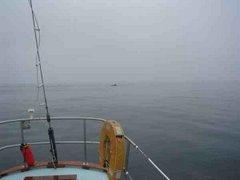
A most amazing race, indeed. The race is over, and we STILL keep running into Farfar. Last night the Psyche crew (not Charlie) and friends enjoyed a luscious dinner party at the Outrigger Canoe Club, right on the Diamond Head side of Waikiki, courtesy of our captain, Steve Calhoun. His generosity overflowed. While we drank our Mai Tai's at sunset, the canoeists were racing down the waves and putting their outriggers away against the wall right next to us. A beautiful tropical sunset, not at sea, but over the hills around Pearl Harbor.
While we stood around enjoying absolutely sumptuous hors d'oeuvres, who should walk in, but the crew of Farfar and their friends. Looking smart and trim, with beautiful wives/girlfriends, we all guffawed and growled, and shook hands yet again. Vonnegut talks about people in your Karass, and how you can't control it. That's the Psyche and Farfar crew. I wonder how many years we will continue to cross tacks.
Then we sat at a long table in the sand, and ate the best meal I've eaten in a very long time.
I am STILL rocking, 30 hours after the race. My muscles are sore all over from the winch grinding and just holding on, in that rocky rolly sea. The callouses are starting to peel off my hands.
I can't help wondering how I would feel about this race if we had sailed 10 minutes slower across 2+ weeks, and lost to the Farfar crew. It is hard to imagine. But I THINK by this long afterward, I'd be getting a sense of perspective.
Bird (my love who came to greet me) and I are sitting in our room in the Bamboo right off Waikiki, considering that we have NO plans, no watch system, no must do, no nothing. It is a real vacation. My colleagues at Chapman call the race a "sailing vacation". Our college president runs in marathons. I'm doubting that his colleagues call it a "running vacation", but maybe they do.
My dad's death memory comes in waves now, not often, but often enough. An emptiness hole feeling that comes to a peak and then dies down over the course of a few minutes. We will be having a memorial service on the 4 August. There will be a gazillion people there; my parents are incredibly social animals, and they've had a pile of years to accumulate close friends. My mom chose the yacht club to honor the primary avocation of my dad, i.e., sailing. I am truly looking forward to hearing from all these old friends, whose stories and humor will help me transform this hole to a fabric of shared memories.
So, that is the last transpac blog. I guess we'll let this series of blogs stand for a while to accumulate your comments. Also, please feel free to comment or email me at wwright at chapman dot edu. Like two years ago, I feel a sense of gratitude to those of you who have told me what fun you had reading the blog. Knowing that you were reading it made it very, very fulfilling to write.
Showing posts with label Dad. Show all posts
Showing posts with label Dad. Show all posts
Thursday, July 26, 2007


Wednesday, July 25, 2007
TranspacBlogII-27D: WE WON!!
Last email (sent the day after, but you can read it for effect) found us with a big question mark.
Farfar racing along to save her time. We struggling not to let them do it.
Beautiful moonlit night. Smooth sea. Wind, 18-24 knots. High tension on board. To sail all this way and not be able to beat them, had us all dry mouthed. The focus of the last 6 hours of the race was downright unhealthy (in the long run).
We realized that what made us fast on that point of sail was the "trimmer", the person on the spinnaker sheet. Andrew and Charlie traded off. They know when to trim and how fast. They caught bunches and bunches of spinnaker collapses. Each collapse is probably worth 10 seconds; too many and we lose.
We Won.
We did it. We saved our time. 9 minutes (90 spinnaker collapses; 40 spinnaker changes; an hour on the wrong jibe), after more than two weeks of match racing.
I can't imagine any other set of opponents grappling for that long.
At the welcome party, we talked with the father/son pair (Mark and Peter English) of the four crew on Farfar. They were just as keyed up and stressed as we were. Bottom line is that we made each other's experience incredibly intense. Take away Farfar, and the race was a mellow slow passage. Add them back in, and we had the experience of a life time. I don't know if any of them or their friends read this blog, but I want to thank them for basically kicking our butts. We saved our time, but they beat us to the barn. But we still...
WON!
Such a crazy scene at the dock. The goofy Psyche crew and their loved ones. Surprises. Charlie's family showed up unannounced (they couldn't stay away). Tom Jorgensen and son Rob flew over just to see the scene. Press people wondering how we did it.
But here's the big thing. My sweet Bird came with layer upon layer of leis. I finally got to experience a little piece of those old black and white photos of my dad in Honolulu, after having won all the trophies and breaking the record in 1951. Leis up to my chin, as happy and relieved as ever could be.
I'll send one more blog tomorrow from our hotel.
Ta Da (Hawaiian for seeyalater)
Monday, July 23, 2007
TranspacBlogII-26: Privilege vs heart
Ok. When I left you yesterday, we were power reaching with the 1.5 oz bullet proof spinnaker, our bow aimed like a cannon at the transom of Farfar. We also had the spinnaker staysail up. All sails flying as we closed on our query. We were getting closer and closer. The wind was howling. Certainly the four crew on Farfar weren't as heroic as the five of us. We made countless sail changes, as the squalls came and went. 1/2 oz chute in the light stuff, 3/4 oz in the heavy stuff, and the 1.5 oz when in the really heavy stuff.
Then the wind died. To the usual 10 knots.
Farfar started to move out on us. But we could see her clear as day, meaning she couldn't be more than 3 miles from us. The 6 AM role call position put us within 3 miles of her.
This means we are officially ahead of Farfar on corrected time. First in class, and 22nd in fleet. Wooohoooooo!!!!!
Then, after role call the shift we expected tonight, started happening. So we jibed to port tack, diverging from Farfar. Her sail sank below the horizon a scant hour later. I must admit to some separation anxiety.
Now it is normally not a good idea, to leave our competition, whom we think we are beating, out on a flyer that might see them pick up an advantagious private wind that could slide them right past us.
But three things made us choose to do this. First, it is the closest jibe to the course home, by 10 degrees. Second, the wind is light, and we don't dominate Farfar in these conditions. Staying with her in these conditions might just backfire. She could just slip away if we did this. Third, there is usually an intensified trade wind as we make landfall on the island of Molokai. We want to be there first.
Besides, this is our last time to test the adage, "Pass on the left."
But of course, 4 hours later, the wind shifted back to the north, forcing us to jibe back to starboard tack, and wonder what happened to Farfar, and if they left us in the dust.
Been thinking a lot about fathers, lately. This has got me to thinking about the various ways the crew of the Psyche came to be sailors.
Jim and I and Charlie are all children of privilege. Our dads encouraged us to sail at an early age. They bought us sailboats, and arranged for us to be trained by our yacht clubs' junior programs. Charlie had the distinct advantage of living in Newport Beach all summer long. Jimmy and I had to commute (in car pools) to LA harbor to be in the junior progam. This meant that we didn't spend as much time racing dinghies, and when it is time to jibe at midnight, Charlie's early childhood results in perfect reactions to vagaries of wind and sea. Jim's and my reactions are good, but not quite as natural.
Now, the remaining two crew members are the peoples' sailors. Steve learned to sail by the seat of his pants. Not because of any junior program, but rather because he just loved it. He was hooked in college, partly because his roomate at USC, Rob Hambleton, another Newport brat just like Charlie, took him out for a race. Steve got so excited, he bought his own boat and has been sailing ever since.
I haven't spoken at all about Andrew Campbell, our snotty nosed, 20 year old bowman. He is perhaps the most remarkable of the five of us. His early sailing experience was as a crew on a variety of keel boats. At some point he told his mom he wanted to be bowman, andshe responded by actually laying out all the lines and pole for him, and taking him through the various maneuvers step by step. I think he was 8 years old. He still remembers the day. But the most likely explanation for Andrew's success lies not primarily with his mom, but with his desire. He just wants to sail keeps on seeking more crew positions. Word of mouth is a powerful messenger, and people have begun to hear that Andrew is an excellent bowman. The reason is that he just loves to sail. He likes all the gadgets and gilhickies that sailors employ, and is really kind of sailing wonk. A bit obsessed with sailing, and especially doing the foredeck work.
But here's an interesting observation. Andrew can steer. Really. He has taken all his steering turns, and some of these have been in very challenging conditions. Now, his reactions to wind changes and seas may not be quite as quick and natural as are Charlie's, but he is damn good. I believe it is because from his various foredeck experiences, he has seen how the skippers of these boats screw it up. But I would never have guessed that a kid with NO dinghy racing experience could be a good helmsman.
I was wrong.
TranspacBlogII-25: Transpac Dads
22July07
We've got Farfar in our sites. Just off the weather bow. We are both sailing on starboard tack, headed for a Molokai rendezvous day after tomorrow. She is sailing a slow low course, apparently blocking the "passing lane". Knowing that the easterly shift in two days will favor boats on the right of the course, we are inclined to let her get to our left. "No!", you all are crying. "Don't do it. Haven't you learned? Pass on the left!"
We did learn. We got this close two days ago, because we took a disadvantageous jibe to the south, searching for better winds, winds the GRIBs said would be there. Winds we ALL knew would be there. The winds WERE there, even stronger than predicted, and that brought us to this point. But now, the GRIBS don't show any advantage to the south for the next two days. When in doubt, point the boat right at the mark and go as fast as you can.
We are.
Well, I'm still thinking a lot these days about dads. There are some truly astounding connections between the dads of the crew of Psyche; connections that none of us suspected. It turns out that the dads of Jim and Charlie and Bill were all good friends. Furthermore, they all sailed Transpac on the same craft, the famous 98 foot ketch Morning Star. The hub of the Transpac connection was my Grandad, Howard W. Wright Sr. He was the navigator on Morning Star in 1949, 51,53, and 55 (actually he assisted my dad who was navigating in 55), and Jim's and Charlie's dads knew him well. Don Barber sailed on Morning Star in 49, and 51. Dad and Henry Buckingham sailed together on the record breaking run of 1955. I knew none of this before we started this race.
Can't help wondering what it must have been like, a bunch of good friends, part of a 16 man crew on an awesomely powerful ketch. The photos of these guys when they arrived in Honolulu in 1955, after sweeping all the trophies and the record, are really cool. They are wearing leis upon leis upon leis. Their eyes just barely peek out over the top of the stack of leis. You can just imagine how they smell. Heady stuff.
And here, in 2007, are their descendants, sailing once again to Honolulu, all on the same boat.
Now it is six hours since I described our position with Farfar. About noon, they started "heating up", heading a bit more to the right. They probably realize that going left is not going to be good when the easterly shift the weather Gribs are predicting takes place. But just now the wind has really piped up, topping 23 knots, but from 040, just a tad north of Northeast. This is a really unusual wind for this part of the course, which generally shows an easterly trade wind. This wind is from 50 degrees farther north. We can only just barely carry our spinnaker on starboard tack. We changed from the 1/2 oz, to the 3/4 oz, and now, by golly, we just changed to the "bullet proof" 1.5 oz spinnaker. This is good for a good deal more wind than this.
Meanwhile, Farfar has given up their quest to go north, and are sailing from right to left, right on our track for home. They are very close, probably three miles dead ahead.
Ok, 2 hours and 4 spinnaker changes later. The wind is howling from North North East. The only sail we can hold is the 1.5. Farfar is wallowing in a calm spot after the last squall. We are coming up on them.
More tomorrow.
P.s. Jim Barber found my glasses in the bilge under my bunk. Yay.
Wednesday, July 18, 2007
TranspacBlogII-22: Sea stories
So, my Dad dying yesterday, changes the hue of this race. Deeper blue.
But beautiful as beautiful can be. We are on this planet for so short a time.
Here's what I would like you all to do, those that know my Dad, Howard W. Wright Jr.
I would like you to post a narrative about Dad.
On the web page.
Because now that he is no longer my dying father through my eyes, I would like to know more about who he was through the eyes of others.
Here's an example story (they don't have to be sailing stories for you, but they do for me).
Back in the 80's, I sailed on Al Martin's Sumatra in the now-defunct Los Angeles to Mazatlan race. Dad and his friend Willard Bell (one of the saltiest warmhearts on this planet). Dad, Willard and I were one watch; Willie Bell(Willard's son), Howard (my brother), and Doug Jorgensen on the other. Al floated onto all the watches. Rosie Bell (Willard's daughter) was cook.
So I thoroughly enjoyed being on watch with Willard and Dad. We sailed hard, and had a good time. Willard and Dad both smoked cigars at the time, and they weren't allowed to do it down below, so naturally they did while we were on watch. Luckily it wasn't too rough, or I would have puked, for sure. There wasn't much wind, so we were doing very poorly (last third of the fleet) going into Cabo San Lucas, on the tip of Baja. Now for those of you that don't know, Cabo San Lucas has a hole many times larger than the one I described at the east end of Catalina in an earlier blog. It is HUGE. It takes infinite patience to get through it.
The best way through the lee, is to have "one foot on the shore." In other words, sail as absolutely close to the shore as you dare. So in we roared from the Pacific Ocean into the hole at Cabo San Lucas. There, we found many tens of sailboats, all previously ahead of us, trying desperately to sail through the hole. It was just starting to be evening as we came into the cape, and added our boat to the frustrated fleet trying to get through to the wind some 15 miles east.
We had three things in our favor. A good fathometer, to tell how deep it was, and a desperate set of helmsmen willing to sail the boat closer to shore than any other boat. But the REAL secret weapon was Willard and Dad's cigars.
Why, you might ask?
Because the wind was so light that it wouldn't affect a tell-tale ribbon. It couldn't be felt on your face. In short, it was almost impossible to detect where this tiniest wisps of air movement were coming from.
Unless you smoked a cigar. So Willard and Dad traded off smoking cigars for our entire 4 hour watch. We sailed the boat SOO close to shore, any of us could easily have swum to it at any time. Water depth got as shallow as 15 feet. NOBODY else dared sail that close to shore.
But, in addition to this daredevil approach to the sea-land interface, we also knew much more precisely than the other boats, where the wind was coming from.
The cigar smoke was an unequivocal read-out of these air wisps, and even though we couldn't feel air, we adjusted the sails according to the smoke read out. It was always right, and we ghosted by virtually every boat in the hole. We got to the Northerlies in the gulf before most of the other boats, and ended up 3rd in our class.
One final note. All that smoking made Willard and Dad snore like buzz-saws.
In unison. Dougie has a tape recording to prove it. My brother Howard had his harmonica with him, and played "On top of old smokie" in time with their snores.
The need for cigar smoke is far behind us on Psyche as I write. We sailed just slightly south of our course to Hawaii, yesterday, pretty much giving up on our plan to get farther south than Farfar. The reason for this is that the tropical depression is breaking up much faster than anticipated, so the intensification of the trade winds is much smaller than we thought. They reported themselves 15 miles ahead of us, but instead of being 13 miles south of us, they were only 3 miles south. And ahead. We need to pour on more coal!
Transpac Blog II-21: Sea Witches.
The tricksters were out last night. The sun went down, and and the goblins had their way with us.
The dark-as-pitchness was worse. The swell was the same. The wind around 15 knots. Really challenging keeping a boat under spinnaker on one track. At 4:30AM we went by the lee, and backwinded the mainsail, causing the boat to tip the WRONG way (away from the boom), like it was completely possessed. Psyche laid over, the eye holding the mainsail onto the rail was badly damaged, but the bullet was dodged. No other damage.
This, just before my watch. I hadn't been handling the spinnaker sheet more than 5 minutes, when I just let go of the damn thing to move over to adjust another line. The sheet ran around the winch and through all the blocks like a piece of spaghetti. I have no idea what I was thinking. I just let go of it. All hands were called, we snagged the thing and got the flogging spinnaker under control without damage. I apologized profusely. The rest of the crew tried to psychoanalyze me (separation anxiety was the consensus).
But all this was caused by the sea witches. Nothing but mischief.
I heard this afternoon that my dad died at home of kidney failure. He was 86 years old. He is the reason I am here, on Psyche, racing to Honolulu. He has always loved hearing my stories about messing up on boats, and everywhere else. He is a good friend of those sea witches. I don't know when he died, but I'm betting he was watching me screw up, egging the sea witches to greater heights.
Dad, I'll be watching for you tonight.
Thursday, July 12, 2007
TranspacBlogII-15: A beautiful beat.
7AM, 12 July 07
Sitting to leeward in the forepeak just before the morning role call. Many of you know that this is a coded way of telling you that there isn't much wind.
We have been beating or close reaching on starboard tack all night with a miraculously constant, but weak breeze.
I wrote of beating to windward in 2005, but I simply must relate last night as an addendum. To remind you, beating is what you do when the wind is coming at you. When where you want to go is where the wind is coming from, meaning you have to sail a bit away from the direct course. Beating to windward is what sets apart really good sailors from mediocre sailors. There is a magic to solving the yin-yang problem of sailing as close to your course as you can but still keep the boat sailing fast.
Old boats, like Psyche, sail best at a true angle of about 45 degrees to the wind, newer boats can sail much closer. There are various ways that sailors decide whether they have pointed their boat too close to the wind (this slows their progress, till they turn a tad away from the wind). Some sail up until the jib 'luffs', that is till it gets a bubble in its front end, as the wind comes around on the wrong side of the sail. Some sailors approach that turn-away point by watching the tell-tales on the front of the jib. If the windward tell-tail flutters skyward, you are heading too close to the wind and need to head a little away. Good sailors keep track of more than whether the tell-tales are fluttering. Most importantly, they sense the boat's speed. If the boat is going really fast for the amount of wind, you can turn a bit closer to the wind for a while; if the boat is going too slow, don't sail so close to the wind.
A really good sailor, but an even more successful father of sailors, named Bob Allen, once suggested to a very young me back in 1967 that I should try steering the boat in an oscillatory course, e.g., 50 degrees from the wind for a while till I hear the boat's bow wave and hear more bubbles hissing by, both indicating increased speed, and then turn the boat ever-so-slightly toward the wind for a spell, then a smooth return to 50 degrees for more speed, and so on. To paraphrase a recent unmentionable quote, you bank your boat-speed 'capital' in yards to windward.
My dad doesn't sail that way. He just finds a very narrow optimal groove and keeps his boat there. When I was first learning how sail to windward in my grandad's old wooden dyer dinghy, my dad told me to "just feel the boat, son."
I didn't feel anything then, but I do now (thanks for telling me that I would, Dad).
The point of all this, is that last night would have been the prototype evening for teaching a youngster what my dad meant. Normally, there are a myriad of sensory inputs that prevent you from "feeling" how fast you are going. Waves come at you in frustrating clumps abruptly slowing you down and changing your course. Other boats are distracting you. A crew member talks and you lose your concentration.
Last night there was wind direction and speed, boat direction and speed, and nothing else; no waves, no wind changes, no crew noise.
I shouldn't say nothing else. Last night was the clearest I can remember in a very long time. Bizillions of stars, and a dominant Milky Way. So much structure to the heavens, that you only needed to refer to your compass now and then, to check in. I used the Milky Way as if it were a palm tree on the shore. There were NO waves. At all. Truly the calmest sea I have seen in a very long time. The wind was incredibly constant, 3.5-5.0 knots. The boat speed ranged between 4.0 and 5.5 knots. These are amazing numbers for an old sailor like me. In these rarified conditions, the boat was actually moving faster than the wind. In these conditions, it was so easy to see the relationship between boat speed and wind angle. You needed hardly move the tiller at all. I must say that I experimented (are you surprised?) with both my dad's stable equilibrium algorithm, and Bob Allen's oscillatory one. The latter is better for me, because I'm never quite sure where the "groove" is, unless I try out everything else. Moving back and forth between a little too high (as evidenced by reduced boat speed), and a little too low (as evidenced by the wider wind angle)lets you sample the sailing space, and get an idea of the morphology of the process. Anyone sailing last night, would have quickly come to understand all this.
This intense meditation on beating to windward alternated with a different kind of meditation when I gave over the helm to my watch mate. The sight of brilliant stars reflected on a barely ruffled sea, was kind of a reunion with the night sky I used to see as a kid, sleeping on the deck of the Siwash, staring up and wondering what it was all about. Last night, the big dipper pointed out the North star, which was right in our wake, reminding us of the radical departure our course is from previous transpackers.
Blah, blah,blah
BREAK BREAK BREAK
News flash. Round 3 to Psyche!
We have KICKED ASS! The role call is in.
We moved from 6th in class, 11th in fleet yesterday to 2nd in class, 3rd in fleet today.
Just like that. We made up something like 35 miles in 24 hours over Farfar, who really tanked. She is behind the other Cal 40, California girl, who is 15 miles behind us. Wow. Amazing. We know that Farfar has as good or better boat speed than we do: the first day convinced us of that. Somehow the different oceans we sailed in treated us very differently.
Now I haven't been completely straight with you. I've been holding our strategy very close to the chest. Some of you, who have been tracking the boats already know what our strategy is. I'll come out with it in words tomorrow.
Subscribe to:
Posts (Atom)